Raga Clock / Instruments / Santoor
Hammered dulcimerThe santoorसंतूर
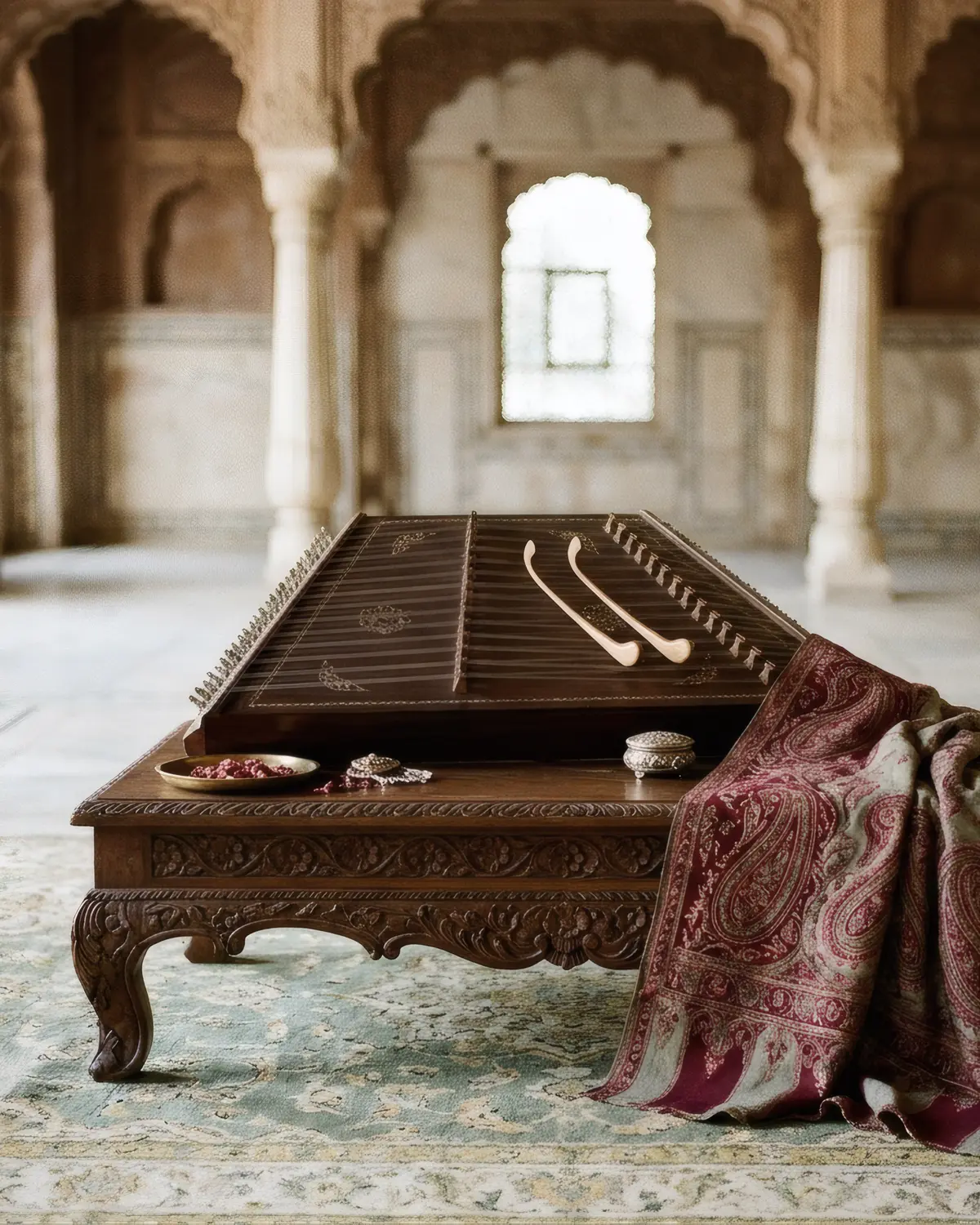
A trapezoid box strung with around a hundred strings, struck with two light, curved wooden mallets. Its notes fall like water.
Play the santoor yourself
How it works
Courses of strings. Each note is a group of strings tuned alike; tiny differences between them add to the santoor's shimmer. You can hear that shimmer in the recordings the player above uses.
Light mallets. The player holds two light, curved wooden mallets loosely and lets them bounce off the strings. Fast alternating strikes make the santoor's tremolo; in the player above, hold a note to hear it.
Few bends. A struck string can't easily be pulled like a sitar's, so the santoor suggests a raga's glides with grace notes and rapid runs instead.
From Kashmir to the concert hall
For centuries the santoor belonged to Kashmir's Sufiana music. Some writers connect it to the shata-tantri veena, the "hundred-stringed veena" mentioned in old Sanskrit texts, though the link is uncertain; it is clearly a cousin of the Persian santur and other hammered dulcimers. Shivkumar Sharma (1938–2022) adapted the instrument and its technique for Hindustani classical music, and his recordings made it a concert instrument.
Every note is a real santoor strike, cut from recordings of twelve different strings and re-tuned to your raga (a synthesized stand-in plays if they can't load). Holding a key repeats the strike quickly, the way a santoor player rolls on one note. The recordings are shared under open licences; see the sound credits.
The real santoor
The full library · From our channel, @indianmusiccentral. Nothing loads from YouTube until you press play.