Raga Clock / Instruments / Sitar
Plucked luteThe sitarसितार
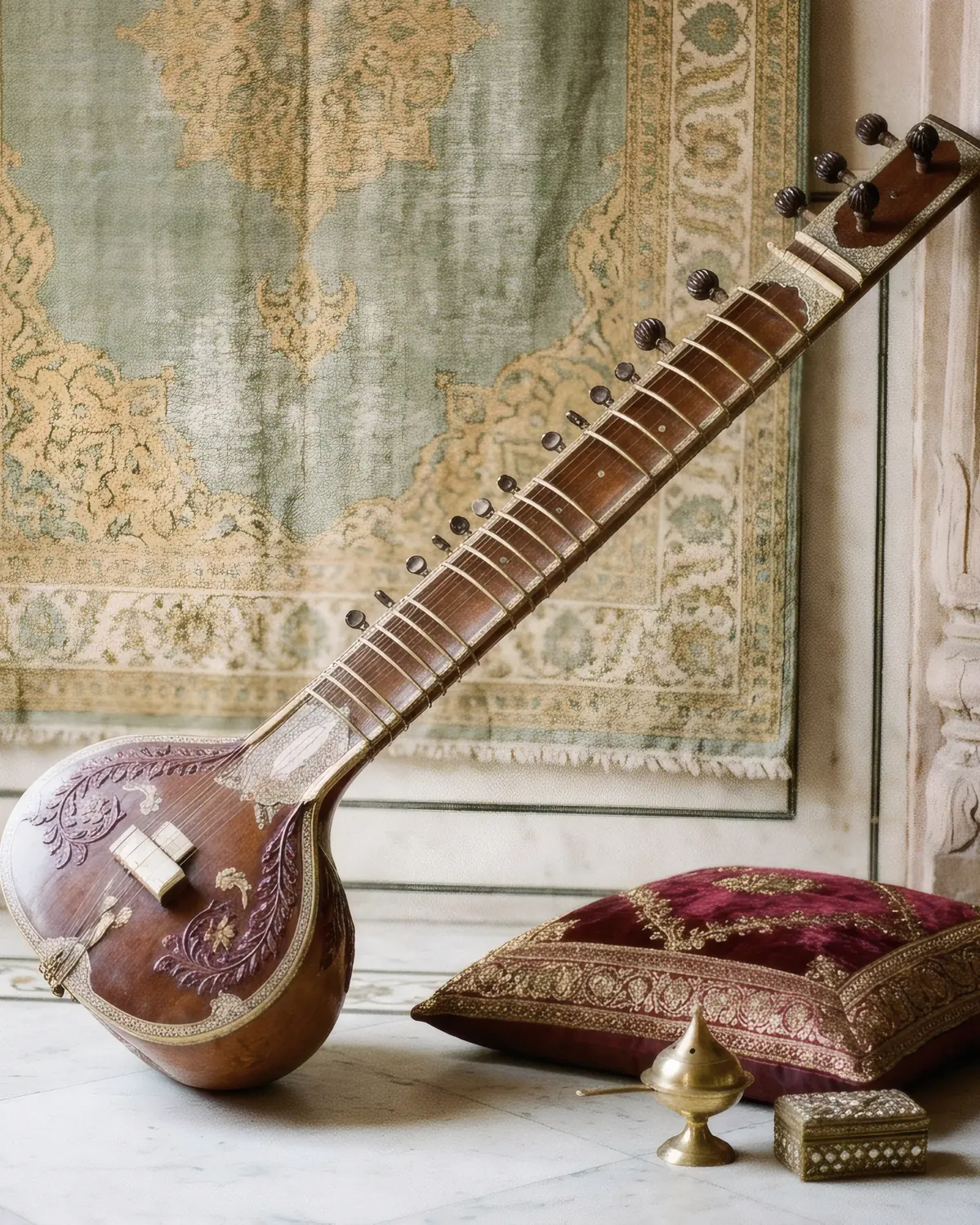
A long-necked lute with curved, movable frets, a gourd resonator, and a bridge that makes every note shimmer and buzz.
Play the sitar yourself
How it works
Frets you can move. The sitar has around 19 or 20 curved metal frets tied to the neck, which players slide to suit a raga.
The bend (meend). Pulling the main string sideways along a fret raises its pitch smoothly, by several notes on a single fret. These long, singing glides are the sitar's signature, and an imitation of the voice. In the player above, hold a note and drag upward.
The jawari bridge. The strings rest on a broad, slightly curved bridge. As a string vibrates, it brushes the curve, and the shimmering, buzzing tone that results is called jawari. The same idea gives the tanpura its sound.
Sympathetic strings (taraf). Under the frets run eleven to thirteen thin strings, tuned to the notes of the raga. Nobody plucks them during a melody; they ring in sympathy when their notes are played, adding a halo of sound.
The plectrum. Sitarists wear a wire plectrum, the mizrab, on the index finger.
A short history
A popular story credits the sitar to the poet Amir Khusrau in the 13th or 14th century, but historians doubt it. The instrument as we know it took shape around the 18th century, and it is probably related both to older Indian lutes and to Persian long-necked lutes such as the setar. In the 20th century, Ravi Shankar and Vilayat Khan developed two of the great modern styles, and in the 1960s Ravi Shankar's concerts and his friendship with George Harrison brought the sitar worldwide fame.
Every note is a real sitar pluck: about twenty single notes cut from one recording, each re-tuned to your raga (a synthesized stand-in plays if they can't load). Holding and dragging bends the recording itself, a little like meend. A master’s touch, ornaments and strumming are of course beyond a page of buttons. The recordings are shared under open licences; see the sound credits.
Sitar from our channel
More like this in the library · From our channel, @indianmusiccentral. Nothing loads from YouTube until you press play.