Basant बसंत
Going upSa Ga Ma Dha Ni SaComing downSa Ni Dha Pa Ma Ga Re Sa
Basant means spring. Strictly a raga of the late night, but in spring, around the Basant Panchami festival, it may be sung at any hour.
Raga Clock / Rooms / Spring
A season · spring, roughly February to April (classically mid-March to mid-May)Basant, Bahar and Hindol: the ragas of spring.
Ragas here: Basant, Bahar, Hindol

In North Indian custom, spring (vasant) begins with the festival of Basant Panchami, usually in late January or February, and runs on toward Holi in March; the classical six-season calendar puts it later, from mid-March to mid-May. It has ragas of its own. Basant, strictly a late-night raga, may be sung at any hour in its season. Bahar, whose name means bloom, dances in zig-zag phrases and is often joined with other ragas, as in Basant-Bahar. Hindol is named after the swing, hindola.
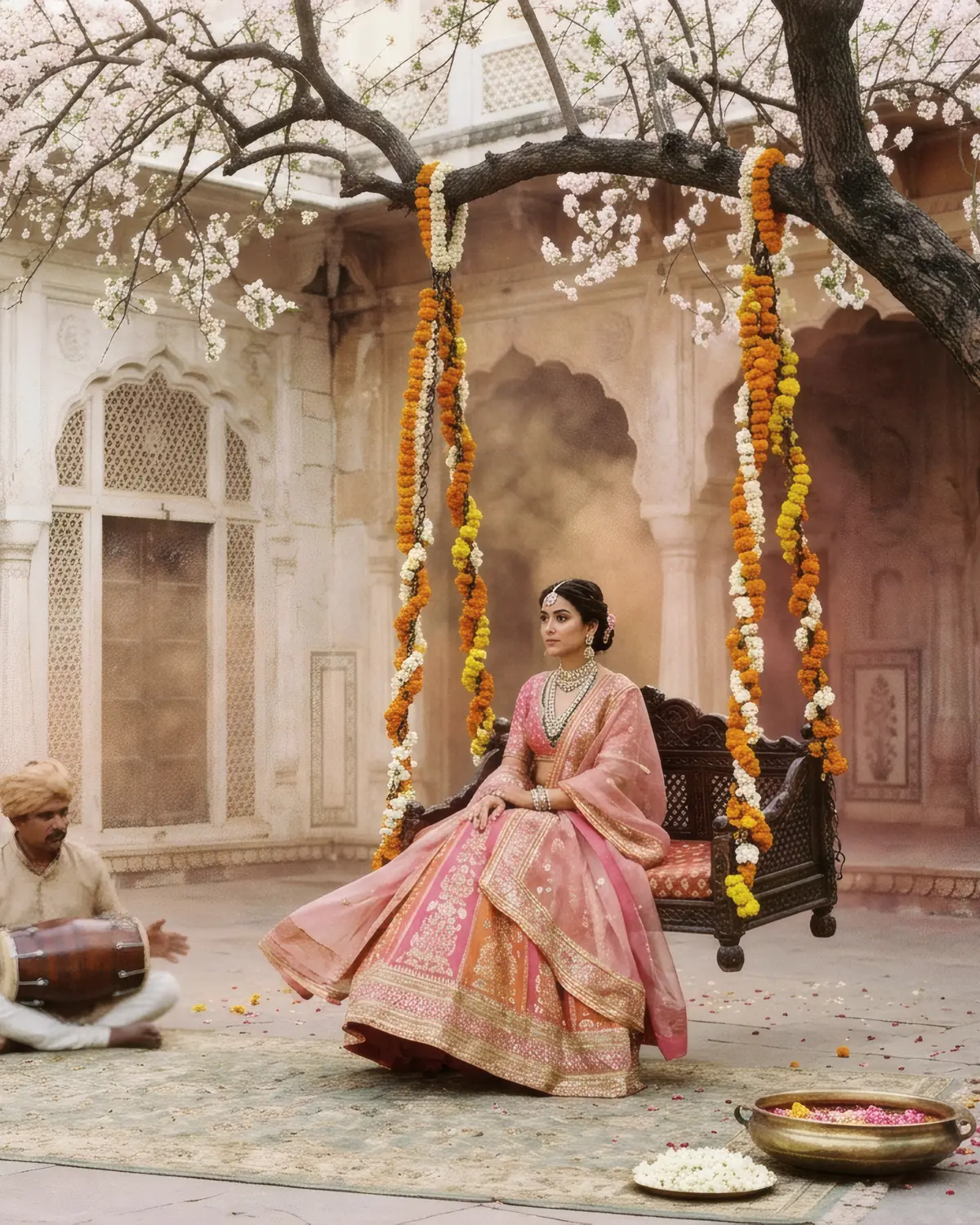
Ragamala paintings of Hindol are built around a swing, often with Krishna and Radha; the photograph above borrows the motif.
Going upSa Ga Ma Dha Ni SaComing downSa Ni Dha Pa Ma Ga Re Sa
Basant means spring. Strictly a raga of the late night, but in spring, around the Basant Panchami festival, it may be sung at any hour.
Going upSa Ma Pa Ga Ma Ni Dha Ni SaComing downSa Ni Pa Ma Pa Ga Ma Re Sa
Bahar means spring, or bloom. A lively raga of zig-zag phrases that uses both forms of Ni, and is often paired with other ragas, as in Basant-Bahar.
Going upSa Ga Ma Dha Ni SaComing downSa Ni Dha Ma Ga Sa
Named after the swing (hindola), which ragamala paintings of Hindol often show. It leaves out Re and Pa and uses tivra Ma.
How to read the notes: an underlined note is komal (flat), Ma with a mark (Ma) is tivra (sharp), and a dot below or above means the octave below or above.
More like this in the library · From our channel, @indianmusiccentral. Nothing loads from YouTube until you press play.
Basant's notes differ between schools (some use both forms of Ma). Old texts name Hindol among the six principal ragas. Most sources place Hindol in the early morning, some after midnight. Spring's dates also differ across India.