Raga Clock / Instruments / Tabla
Hand drumsThe tablaतबला
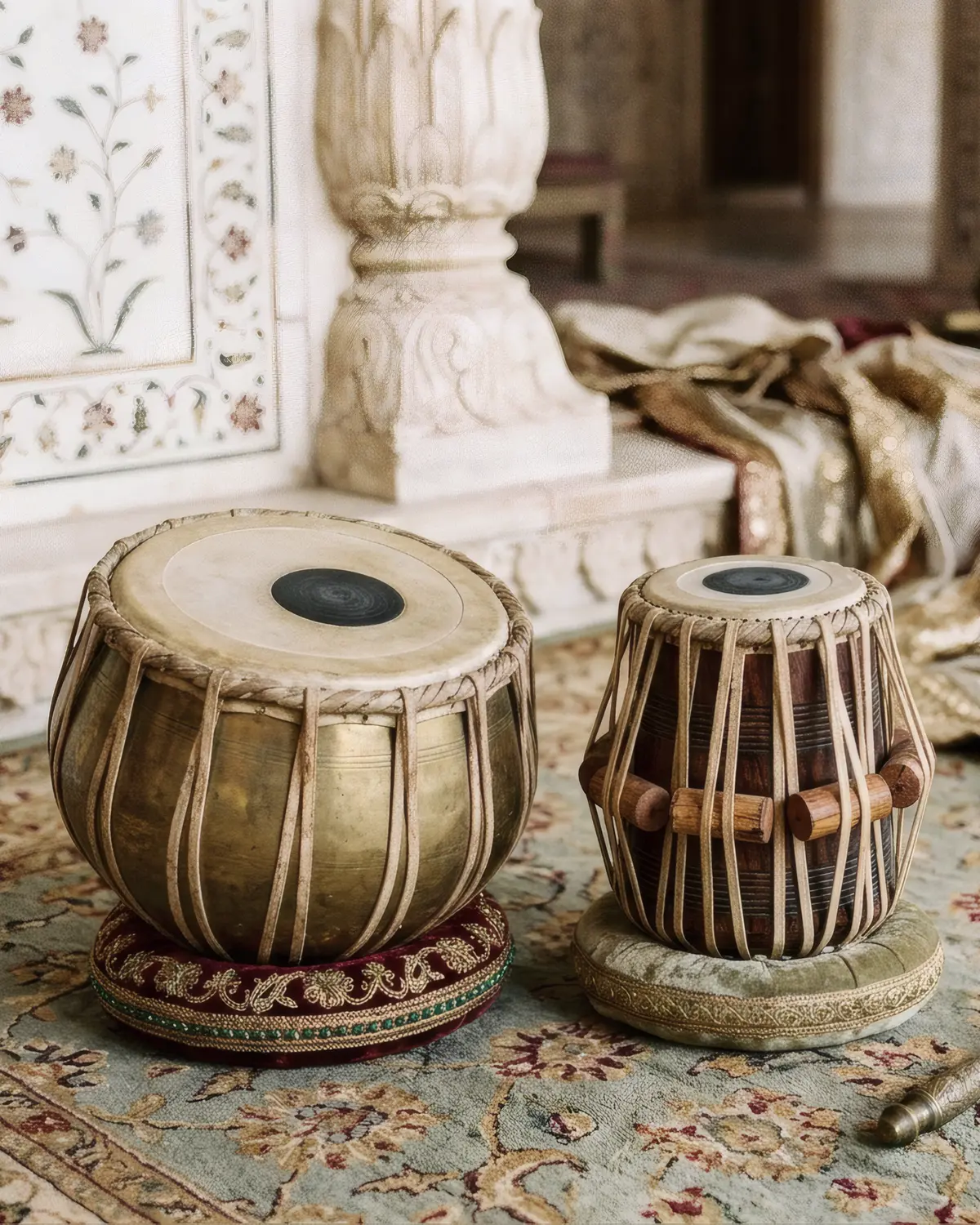
Two drums played with the fingers and palms: a small, tuned treble drum and a deep bass drum whose pitch the player bends with the heel of the hand.
Play the tabla yourself
Tap the strokes, or start a taal and watch the cycle go round. X marks sam, the first beat; 0 marks khali, the "empty" beat, shown with a wave of the hand.
The two drums
Dayan, the right-hand drum, is carved from wood and tuned to the raga's Sa by tapping the leather braces and wooden blocks on its side. Bayan, the left-hand drum, is larger, often of metal, and gives the bass; pressing and sliding the heel of the hand on its head makes the pitch swoop.
The black circle on each head, the syahi, is a hardened paste built up in many thin layers. It shapes the drum's overtones so that the dayan rings with a clear, singable pitch.
Bols: strokes with names
- Na / Ta: a ringing stroke on the rim of the dayan.
- Tin: a softer ring nearer the centre. Tun: an open stroke on the syahi, with a long ring.
- Ti / Te: a closed, damped stroke.
- Ge: the open bass of the bayan. Ke / Ka: a flat, closed slap on the bayan.
- Dha is Na and Ge together; Dhin is Tin and Ge together.
Taals: rhythm cycles
A taal is a cycle of beats divided into sections (vibhags). Players mark it with claps (tali) and a wave of the hand (khali). The cycle always comes home to the first beat, sam, and musicians love to land there together after long improvisations.
- Teentaal, 16 beats (4+4+4+4): one of the most common taals in Hindustani music.
- Jhaptaal, 10 beats (2+3+2+3).
- Rupak, 7 beats (3+2+2): unusually, its first beat is a wave, not a clap.
- Keherwa, 8 beats, and Dadra, 6 beats: lighter cycles used in songs and lighter classical forms.
A short history
As with the sitar, a popular story credits the tabla to Amir Khusrau, which historians doubt. The tabla probably developed around the 18th century, drawing on the older barrel drum, the pakhawaj, and other drums. Six main schools (gharanas) are usually named: Delhi, Ajrada, Lucknow, Farukhabad, Benares and Punjab. In our time, Zakir Hussain (1951–2024) became its best-known ambassador.
Every stroke is a real tabla recording: Na, Ta, Tin, Tun and Te on the right drum, and Ge and Ke on the left. The right drum is re-tuned to follow your Sa; the left keeps its own deep pitch. If the recordings can't load, a synthesized stand-in plays. Real playing has dozens more strokes and endless shades between them. The recordings are shared under open licences; see the sound credits.
Tabla from our channel
More like this in the library · From our channel, @indianmusiccentral. Nothing loads from YouTube until you press play.