Bageshri बागेश्री
Going upNi Dha Sa Ga Ma Dha Ni SaComing downSa Ni Dha Ma Ga Re Sa
A late-night raga of longing built around komal Ga and komal Ni. Pa is used sparingly or not at all, depending on the school, so the tanpura is often tuned to Ma.
Raga Clock / Rooms / Night
A time of day · about 10 pm–4 amBageshri, Darbari, Malkauns and Sohini, deep into the dark.
Ragas here: Bageshri, Darbari Kanada, Malkauns, Sohini
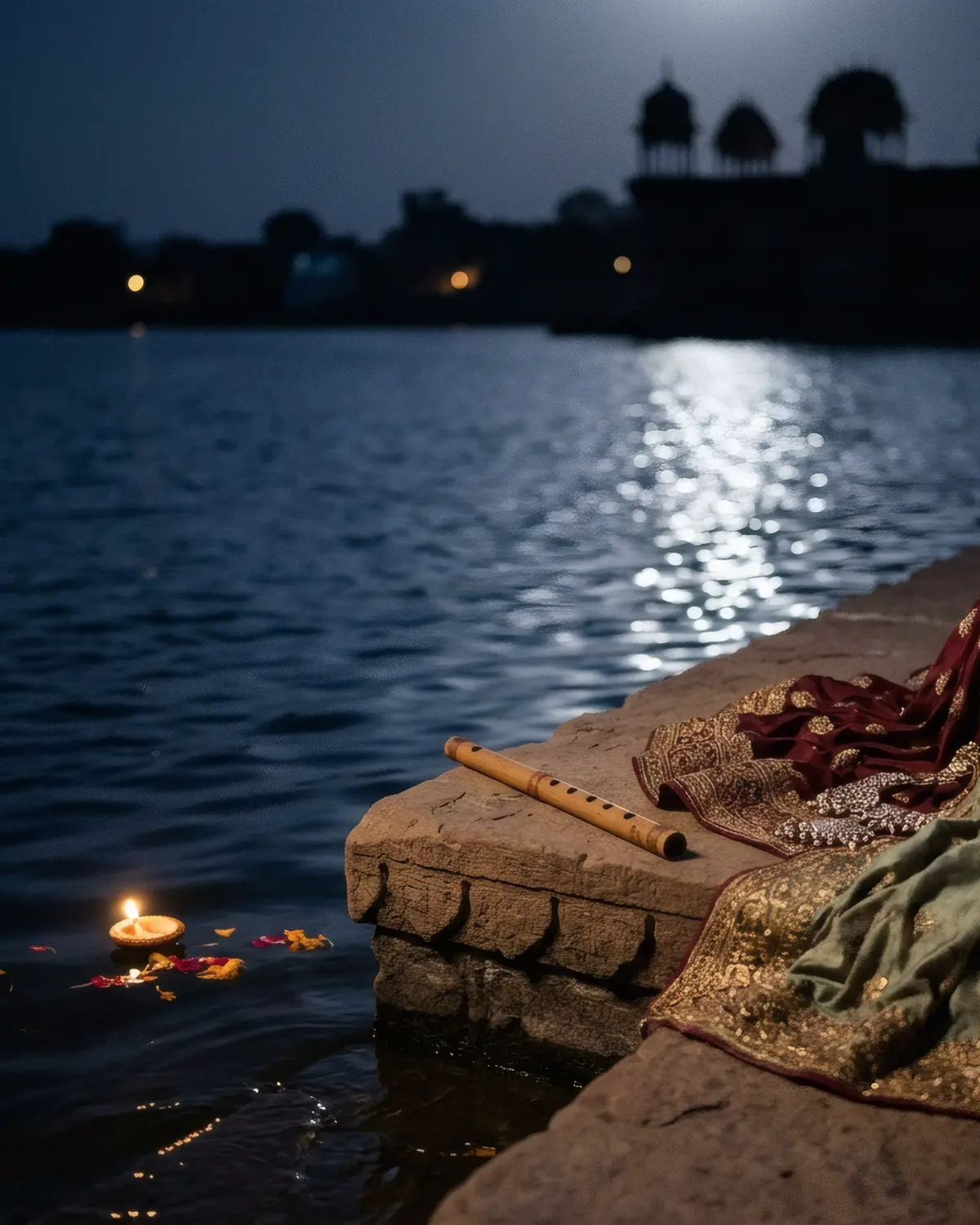
Late at night the music slows and drops low. Bageshri is a raga of longing. Darbari Kanada, the "raga of the court", is sung around midnight, deep and majestic, with wide swings on flat Ga and Dha; tradition links it to Tansen at the Mughal emperor Akbar's court. Malkauns, five notes with no Re and no Pa, belongs to the hours after midnight. At the very end of the night comes Sohini, high and bright, looking toward dawn.
Night ragas are often sung slowly, with a long opening without drums (the alap) before the tabla comes in.
Going upNi Dha Sa Ga Ma Dha Ni SaComing downSa Ni Dha Ma Ga Re Sa
A late-night raga of longing built around komal Ga and komal Ni. Pa is used sparingly or not at all, depending on the school, so the tanpura is often tuned to Ma.
Going upSa Re Ga Ma Pa Dha Ni SaComing downSa Ni Dha Pa Ma Ga Re Sa
Named after the royal court (darbar), and linked by tradition to Tansen at Akbar's court. It is sung around midnight, slowly and low, with a wide oscillation on komal Ga and komal Dha.
Going upSa Ga Ma Dha Ni SaComing downSa Ni Dha Ma Ga Sa
Five notes, with no Re and no Pa, sung deep in the night. Malkauns is usually given a grave, meditative character. Because it has no Pa, the tanpura is tuned to Ma instead.
Going upSa Ga Ma Dha Ni SaComing downSa Re Sa Ni Dha Ma Ga Re Sa
A raga of the very end of the night, from the Marwa family, sung mostly in the upper octave with a sharp, bright beauty. Like Marwa, it leaves out Pa.
How to read the notes: an underlined note is komal (flat), Ma with a mark (Ma) is tivra (sharp), and a dot below or above means the octave below or above.
Malkauns has no Pa, so its tanpura is tuned to Ma.
More like this in the library · From our channel, @indianmusiccentral. Nothing loads from YouTube until you press play.

Some place Bageshri in the evening and others late at night, and whether it uses Pa depends on the school. Sohini sits at the very end of the night for most, at dawn for some.