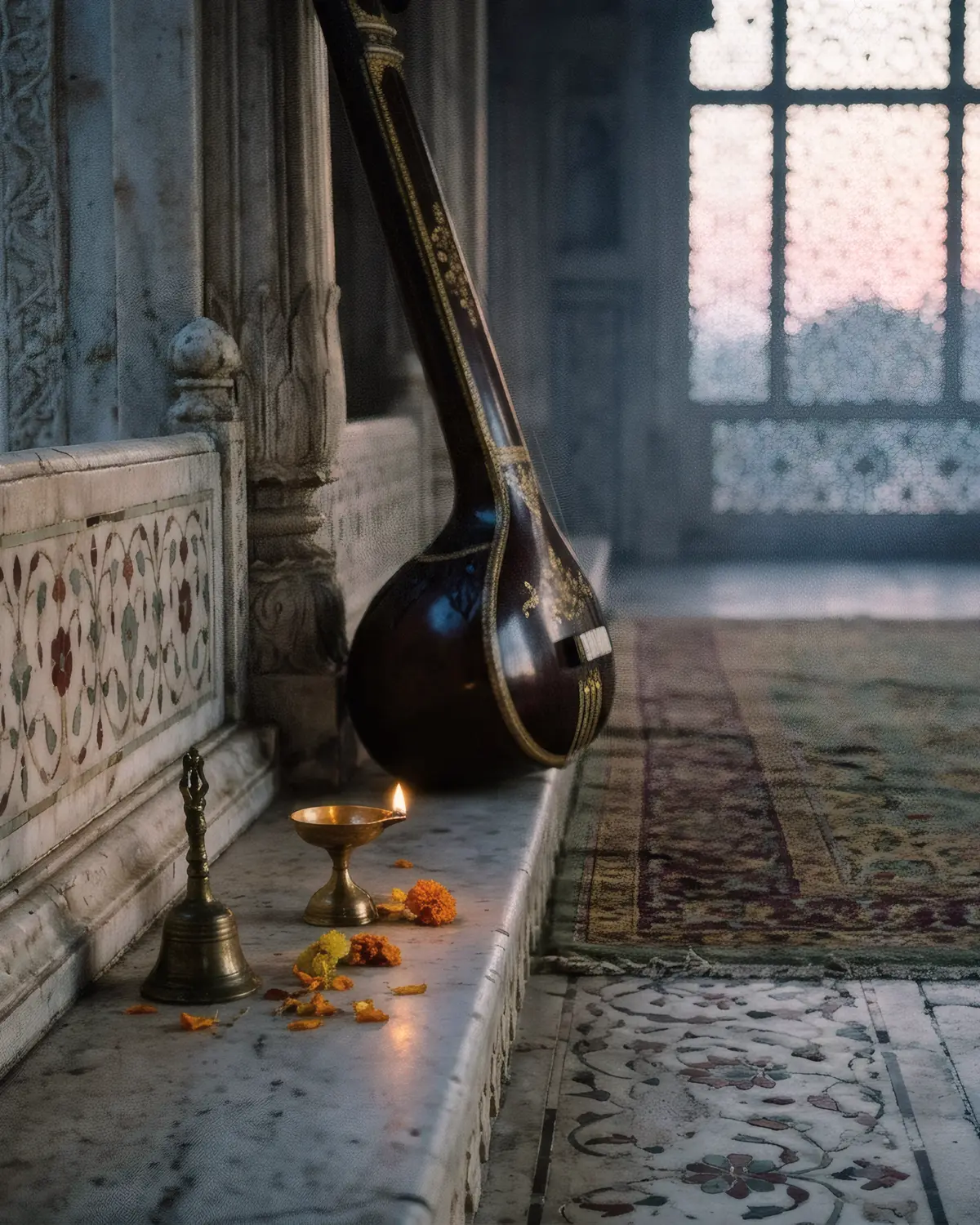
The last hour of the night and the first grey light are a junction, a sandhi, and the ragas of this hour sound like it. Lalit belongs to the end of the night, with both forms of Ma placed side by side and no Pa at all. Bhairav greets the dawn itself: one of the oldest and weightiest ragas, with flat Re and flat Dha sung in slow, heavy swings.
Bhairav is named after a fierce form of Shiva, and many morning ragas share its family of notes. In ragamala paintings, Bhairav is usually pictured as Shiva himself, often seated with Parvati or as an ash-smeared ascetic.
Lalit ललित
Last part of the night, toward dawn · about 3–6 am
Parent scale (thaat): Marwa or Purvi (books disagree)
Going upNi Re Ga Ma Ma Dha Ni SaComing downSa Ni Dha Ma Ma Ga Re Sa
A raga of the last hour of night, unusual for using both forms of Ma side by side and for leaving out Pa altogether. Writers disagree about its parent scale: some file it under Marwa, others under Purvi.
Traditionally described as hushed, yearning, expectant.
Bhairav भैरव
Dawn, the first watch of the day · about 5–8 am
Parent scale (thaat): Bhairav
Going upSa Re Ga Ma Pa Dha Ni SaComing downSa Ni Dha Pa Ma Ga Re Sa
One of the oldest and most important morning ragas, named after a fierce form of Shiva. Komal Re and komal Dha are sung with a slow, heavy oscillation (andolan) that gives it a grave, prayerful character.
Traditionally described as grave, devotional, steady.