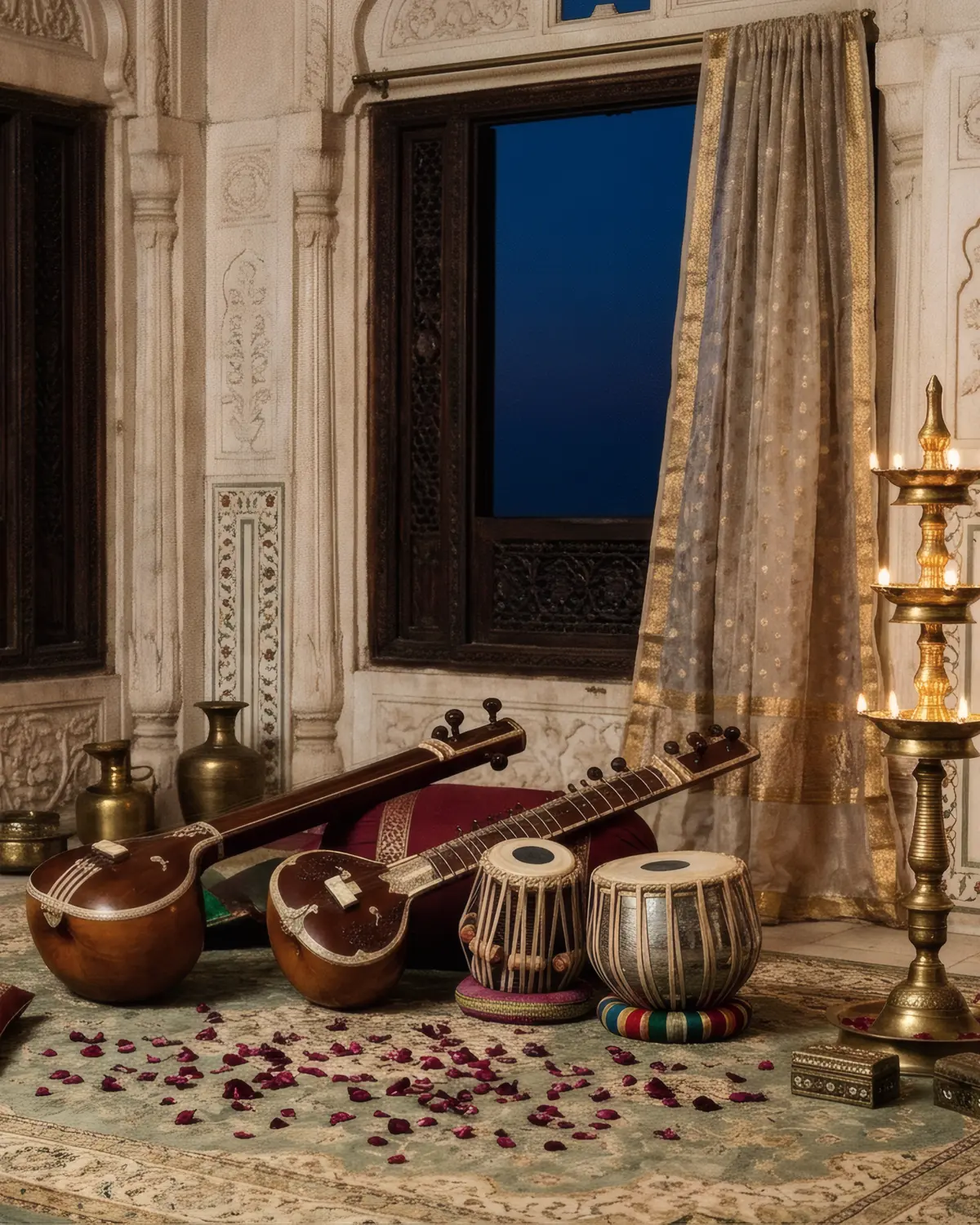
The first watch of the night is when many concerts begin, and its ragas are among the best loved. Yaman, with its sharp Ma, is often among the first ragas a student learns, and masters spend a lifetime on it. Bhupali uses just five notes, the same shape as the major pentatonic heard around the world. Hamsadhwani came north from the Carnatic tradition of South India in the 20th century.
Hamsadhwani's name means "the cry of the swan", and South Indian concerts often open with a piece in it.
Yaman यमन
First part of the night · about 7–10 pm
Parent scale (thaat): Kalyan
Going upNi Re Ga Ma Dha Ni SaComing downSa Ni Dha Pa Ma Ga Re Sa
Often among the first ragas a student learns, and one of the most performed. The sharp (tivra) Ma gives it a bright, serene glow. It belongs to the first part of the night, just after dusk.
Traditionally described as serene, luminous, devotional.
Bhupali भूपाली
Early night · about 8–11 pm
Parent scale (thaat): Kalyan
Going upSa Re Ga Pa Dha SaComing downSa Dha Pa Ga Re Sa
Five notes, Sa Re Ga Pa Dha, and nothing else: the same shape as the major pentatonic heard all over the world. Raga Deshkar uses the very same five notes but stresses different ones and is sung in the morning, which is a good reminder that a raga is more than its scale.
Traditionally described as peaceful, open, gentle.
Hamsadhwani हंसध्वनि
Evening · about 8–11 pm
Parent scale (thaat): Bilaval
Going upSa Re Ga Pa Ni SaComing downSa Ni Pa Ga Re Sa
A five-note raga from South India's Carnatic tradition, traditionally credited to the 18th-century composer Ramaswami Dikshitar. Hindustani musicians took it up in the 20th century and sing it in the evening.
Traditionally described as joyful, light, auspicious.