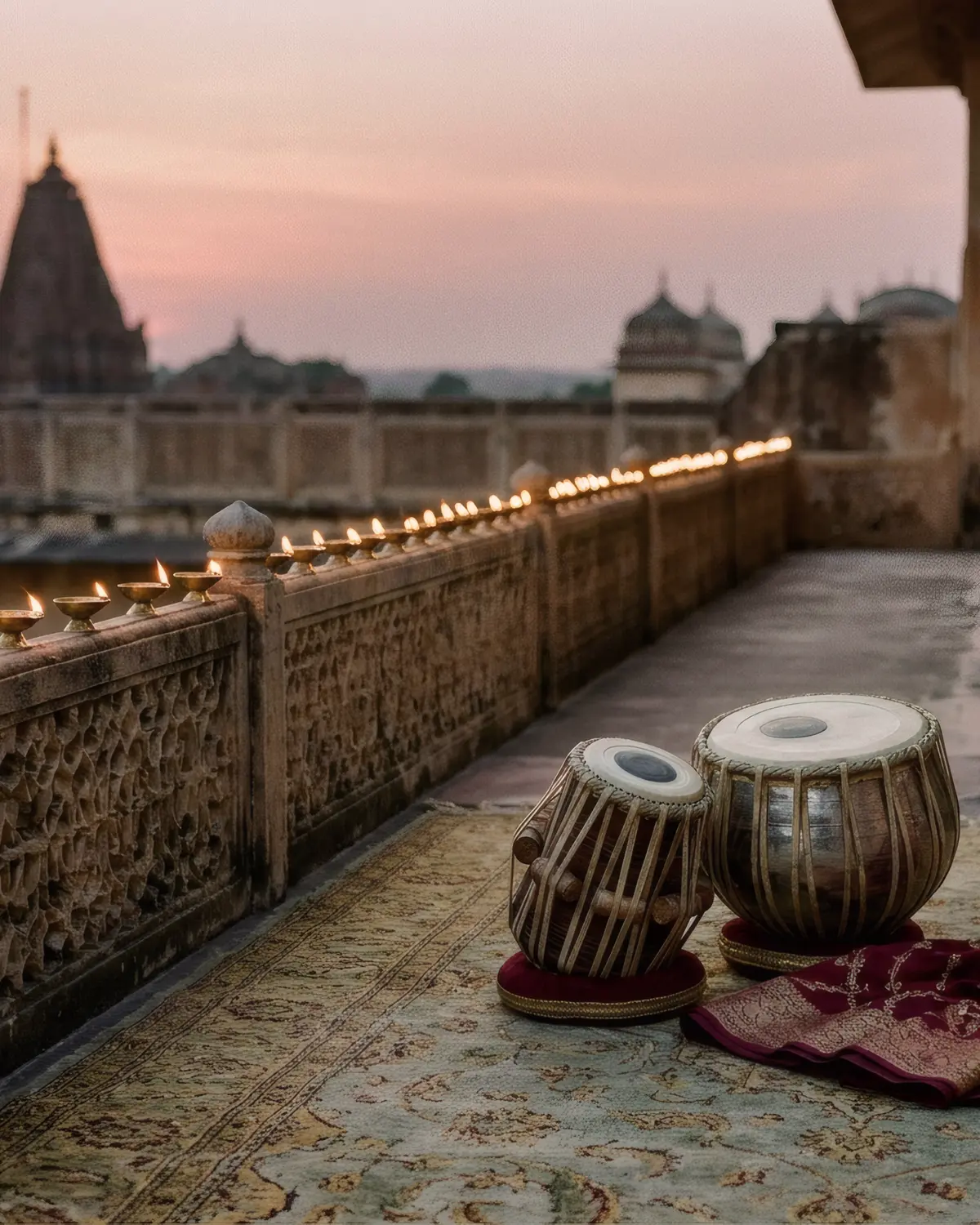
The second great junction of the day is sunset, sandhya, when lamps are lit in homes and temples. Multani comes first, as the heat breaks into gold. Then Marwa: no Pa, a Sa touched only lightly, and a pull between flat Re and natural Dha that sounds unsettled as the light goes. Puriya Dhanashree restores Pa and turns the same twilight warm.
Like the dawn ragas, the sunset ragas lean on flat Re with natural Ga and Ni: the "twilight" family that early 20th-century writers used to explain the time system.
Multani मुलतानी
Late afternoon · about 3–6 pm
Parent scale (thaat): Todi
Going upNi Sa Ga Ma Pa Ni SaComing downSa Ni Dha Pa Ma Ga Re Sa
A late-afternoon raga of the Todi family, with komal Re, komal Ga, tivra Ma and komal Dha, and with Re and Dha skipped going up. It is sung as the heat of the day begins to break.
Traditionally described as intense, golden, poised.
Marwa मारवा
Sunset, the junction of day and night · about 5–7 pm
Parent scale (thaat): Marwa
Going upDha Ni Re Ga Ma Dha Ni SaComing downSa Ni Dha Ma Ga Re Sa
A sunset raga with no Pa, in which even Sa is touched only lightly. The pull between komal Re and shuddh Dha gives it a restless, searching mood that musicians link to the moment the light goes.
Traditionally described as restless, searching, grave.
Puriya Dhanashree पूरिया धनाश्री
Sunset · about 6–8 pm
Parent scale (thaat): Purvi
Going upNi Re Ga Ma Pa Dha Ni SaComing downSa Ni Dha Pa Ma Ga Re Sa
Another sunset raga, close to Marwa in colour but warmer, with Pa restored. It sits right at the junction of day and night, when lamps are lit.
Traditionally described as warm, devotional, glowing.